The American Association of Orthodontists recommends age 7 — here's why early evaluation matters even if treatment doesn't start right away
Most parents wait until their child's teeth look obviously crowded before scheduling an orthodontic consultation. You figure you'll know when it's time — when the teeth are visibly crooked, or when the dentist says something. Until then, it can wait.
But orthodontists — and the American Association of Orthodontists — recommend a first evaluation much earlier than most parents realize. The recommended age is 7. And while that might sound surprisingly young, there are very good reasons for it.
Why Age 7?
By age 7, most children have a mix of baby teeth and permanent teeth. This combination gives an orthodontist a clear picture of how the jaw is developing, how the permanent teeth are erupting, and whether any issues are forming that would be easier — and less expensive — to address now rather than later.
At this age, the jaw is still growing. Certain problems that would require surgery or tooth extraction in a teenager or adult can often be corrected with simple, non-invasive appliances in a young child. The window for this kind of early intervention is narrow, and it closes as the jaw finishes developing.
This doesn't mean your 7-year-old needs braces. In the majority of cases, the evaluation simply confirms that everything is developing normally and that no action is needed yet. But it establishes a baseline, and it means that if something does need attention, you catch it at the optimal time.
What Orthodontists Look for at Age 7
A first orthodontic evaluation at age 7 isn't about aesthetics — it's about function and development. Dr. Larson looks for several specific things:
Jaw development. Is the upper jaw growing wide enough to accommodate the incoming permanent teeth? Narrow jaws can cause crowding that becomes severe by the teenage years. A palate expander used at age 7 or 8 can address this in months; the same correction at age 14 may require surgery.
Bite patterns. Crossbites, underbites, and deep overbites are much easier to correct while the jaw is still growing. Early treatment can guide jaw development in the right direction and prevent more complex problems later.
Tooth eruption sequence. Are the permanent teeth coming in where they should? Teeth that are erupting in the wrong position — or not erupting at all — can cause significant problems if left unaddressed.
Space management. If baby teeth are lost early due to decay or injury, the surrounding teeth can drift into the empty space, blocking the path for the permanent tooth that needs to come in. A space maintainer can prevent this.
Early Treatment vs. Waiting: How to Think About It
Not every child who is evaluated at age 7 needs early treatment. In fact, most don't. The purpose of the evaluation is to identify the cases where early intervention would make a meaningful difference — and to give parents the information they need to make a good decision.
When early treatment is recommended, it's typically called Phase 1 treatment. This might involve a palate expander, a partial set of braces on specific teeth, or a simple removable appliance. Phase 1 treatment usually lasts 9 to 12 months and is followed by a resting period while the remaining permanent teeth come in. Phase 2 — full braces or aligners — follows later, often for a shorter duration than it would have been without Phase 1.
The alternative — waiting until all the permanent teeth are in — is appropriate for many children. But for children with jaw development issues, bite problems, or severe crowding, waiting means allowing a correctable problem to become more complex. The treatment required at age 13 or 14 is often more involved, more expensive, and harder on the patient than what could have been done at age 7 or 8.
Signs That Your Child Should Be Evaluated Sooner
While age 7 is the standard recommendation, there are situations where an earlier evaluation makes sense. Consider scheduling a consultation if your child:
- Has difficulty chewing or biting
- Breathes primarily through their mouth
- Sucks their thumb or fingers past age 5
- Has teeth that don't meet properly when biting
- Has lost baby teeth earlier or later than expected
- Has visible crowding or spacing issues
- Grinds their teeth at night
None of these are emergencies, but they're all reasons to get a professional opinion sooner rather than later.
What to Expect at a First Evaluation
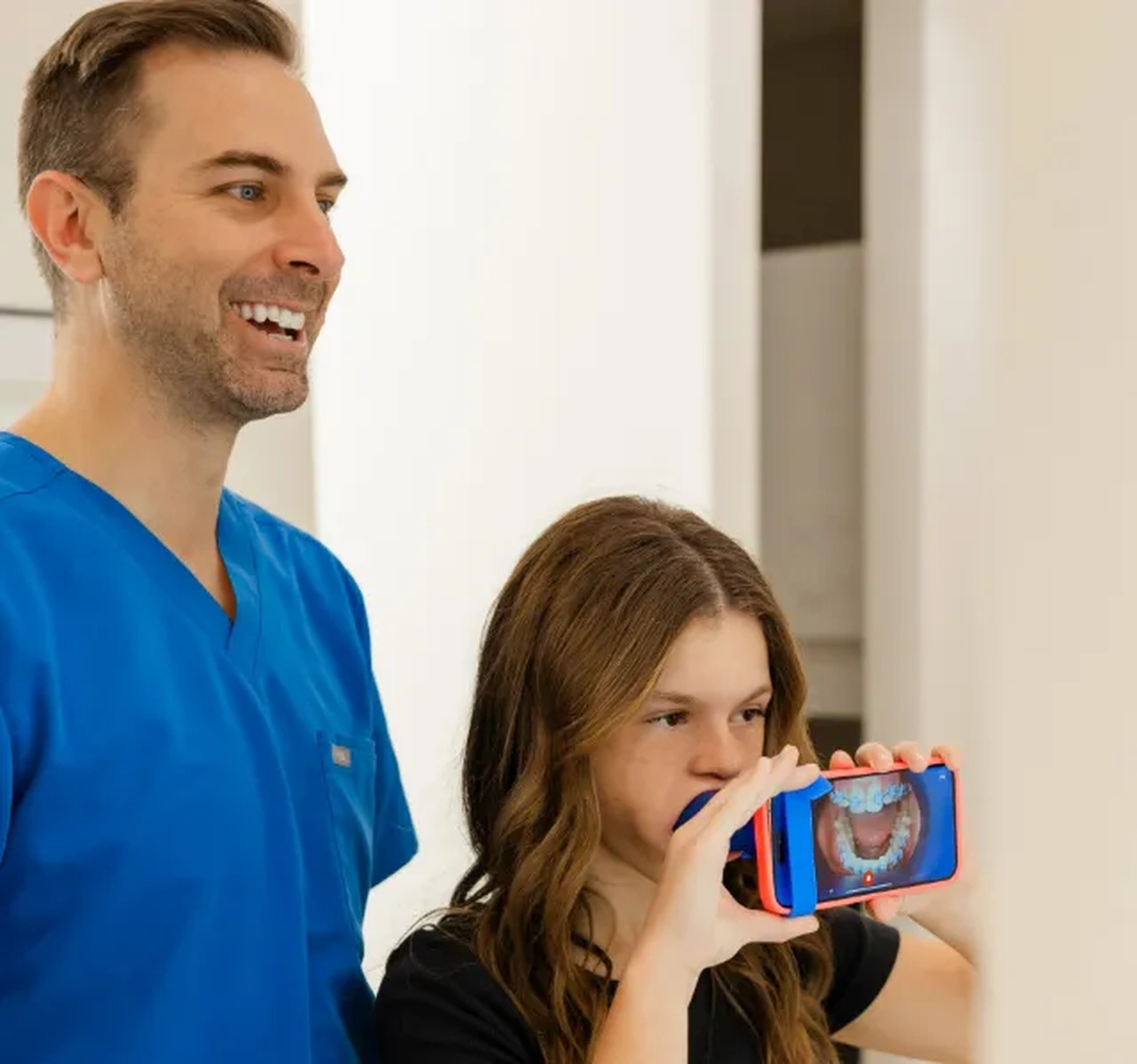
At Larson Family Orthodontics, a first evaluation for a child is a relaxed, no-pressure visit. Dr. Larson uses a digital scanner — no messy impressions — to get a clear picture of how the teeth and jaw are developing. He'll explain what he sees in plain language, give you his honest recommendation, and answer every question you have.
If no treatment is needed, you'll leave with peace of mind and a plan to monitor development over time. If early treatment would be beneficial, you'll understand exactly why, what it involves, and what the alternative looks like.
There's no charge for the initial consultation. And there's no obligation to proceed with anything.
The Takeaway
The best time to have your child evaluated by an orthodontist is earlier than most parents think — around age 7. Not because treatment is likely to start immediately, but because the information you get from that evaluation is genuinely valuable. It either confirms that everything is on track, or it identifies an issue at the optimal time to address it.
At Larson Family Orthodontics, we see early evaluations as part of our commitment to long-term patient outcomes — not just a way to start treatment sooner. If your child is approaching age 7, or if you have concerns about their dental development at any age, we'd love to take a look.